
A first-time client leaves your barbershop with a haircut they are happy with.
They say they will be back. Then the weeks pass. They forget the shop name, book somewhere closer or return only when they happen to think of it.
This is a familiar problem for barber shops. Hair grows, so customers often need another cut after a period of time. But needing another haircut does not always mean choosing the same barber. The next visit still needs to be remembered, booked and completed.
A simple loyalty program can give that relationship more structure.
It can recognise a completed visit, show the client their progress and give them a practical reason to choose your chair again. The program does not guarantee repeat visits. It works alongside the things that matter most, including a good cut, reliable service, convenient booking and a shop customers are comfortable returning to.
For many barber shops, a visit-based digital loyalty program is a sensible place to start. It is easy to explain, straightforward for staff and closely matched to the way customers buy.
Why barber shops use loyalty programs
A barber loyalty program is not simply a discount scheme. It is a way to create a clearer relationship after the first service.
Supporting the natural repeat cut cycle
Most clients do not need to be convinced that their hair will grow back. They already understand that another cut will be needed.
The challenge is choosing where and when that next cut happens. A loyalty program can keep your barbershop in the consideration set by connecting the next visit to visible progress or a useful reward.
The timing will vary between clients. Someone with a short fade may return sooner than someone who prefers a longer style. The program should allow for that variation rather than assuming every customer follows the same schedule.
Building a more predictable book of regulars
A growing group of regular clients can make the working week easier to plan. It may help a barber shop understand which customers book repeatedly, which services they use and where follow-up could be useful.
This is not the same as guaranteeing a fuller book. A loyalty program cannot replace good scheduling, service quality or local marketing. It gives repeat activity a structure that would otherwise be left to memory.
Recognising customers who keep choosing you
Some clients value being recognised as much as they value the financial reward.
A loyalty program gives staff a consistent way to acknowledge repeat customers. The reward might be a service add-on, an upgrade or a product benefit rather than a free haircut.
That flexibility matters because a reward that is appreciated by the client may be easier for the business to provide sustainably.
Creating another reason to recommend the shop
A happy regular may be more comfortable recommending your barbershop to a friend. A referral benefit can be included in some programs, but it should be treated as an optional feature rather than the central purpose.
Start with the relationship between the shop and the client who has already visited. Make that experience clear and useful first.
What makes a barber loyalty program simple?
For most barber shops, a visit-based loyalty program is easier to manage than a complex points system.
The basic structure is:
- 01The customer joins.
- 02A qualifying completed service earns one visit or stamp.
- 03The customer sees progress towards a defined reward.
- 04The reward is redeemed when the required progress is reached.
The exact number of visits is a business decision. Do not copy another barbershop’s threshold without checking your own service prices, margins and customer return patterns.
Your terms should answer a few basic questions:
- Which services qualify?
- Does a standard cut, beard service or premium appointment earn a stamp?
- Can a customer earn more than one stamp during a single visit?
- Do walk-ins and booked appointments follow the same rules?
- Are no-shows excluded?
- How is a reward redeemed?
- Does the reward expire?
- Can the reward be used with another offer?
A customer should be able to understand the program in one short explanation.
If the team needs several minutes to explain the offer, the structure may be doing too much.
Digital loyalty cards for barbers
A digital loyalty program for barbers can use a branded pass saved to Apple Wallet or Google Wallet. The pass gives customers a way to access their reward progress from the phone they already carry.
It does not need to be a separate customer app.
A QR code at the counter, mirror or barber station can take a client to the sign-up process. They can then follow the relevant steps to save the card to their device. Keep the joining process short and ask only for information that the program genuinely needs.
Apple’s documentation explains that loyalty passes can support visits, points, offers and rewards. It also lists QR codes, websites, SMS and email among the ways businesses can distribute passes. Read Apple’s guide to loyalty and membership passes for the platform details.
Google Developers explains that loyalty cards can be saved to Google Wallet and issued through supported channels such as websites, email and SMS. See the Google Wallet loyalty card overview.
The exact customer experience depends on the device, wallet and program setup. The important operational principle is consistent:
Scan. Save. Visit. Reward.
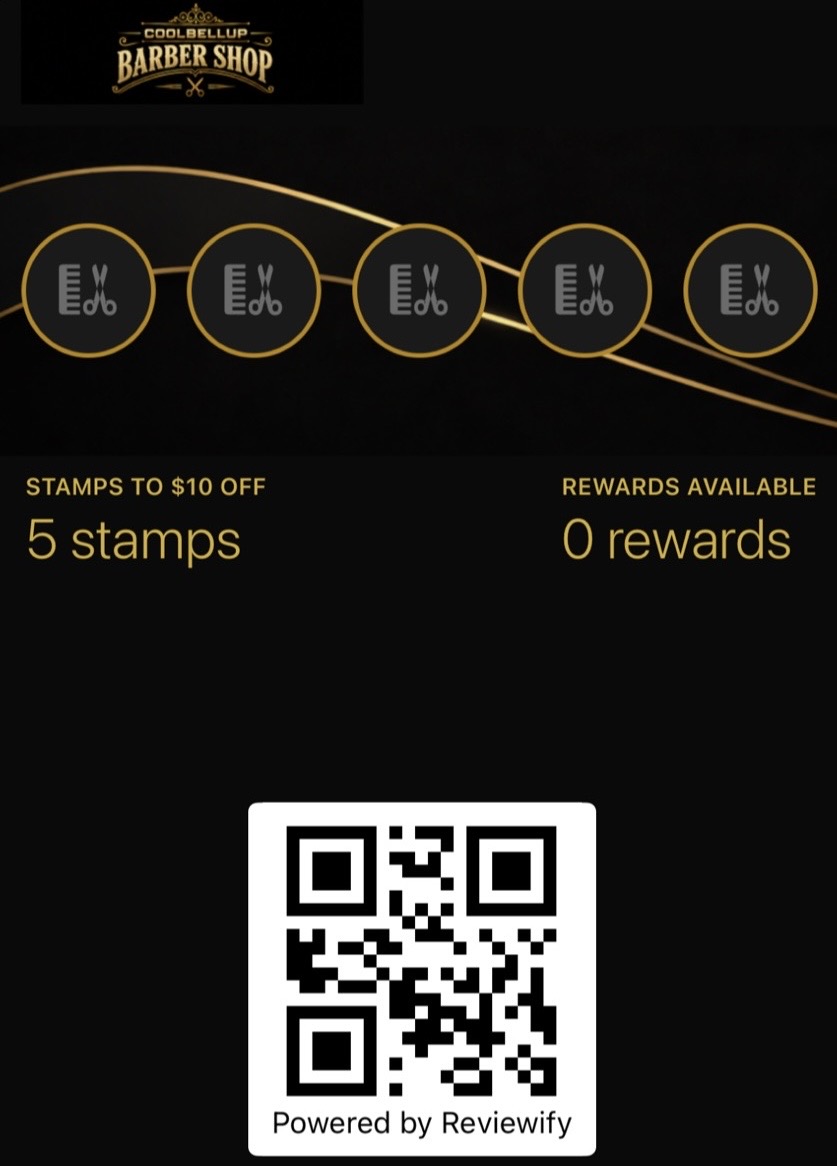
A digital barber shop loyalty card can show:
- The barbershop’s name and branding
- The current visit or stamp count
- The reward being worked towards
- A barcode or scannable pass
- Useful links, such as booking details
- Relevant loyalty updates, where supported
For more background, see What is a digital loyalty card?. The more important question for a barber shop is how the card fits into the service workflow.
How to use a digital loyalty program at the counter
A loyalty program should not add a long task to an already busy checkout.
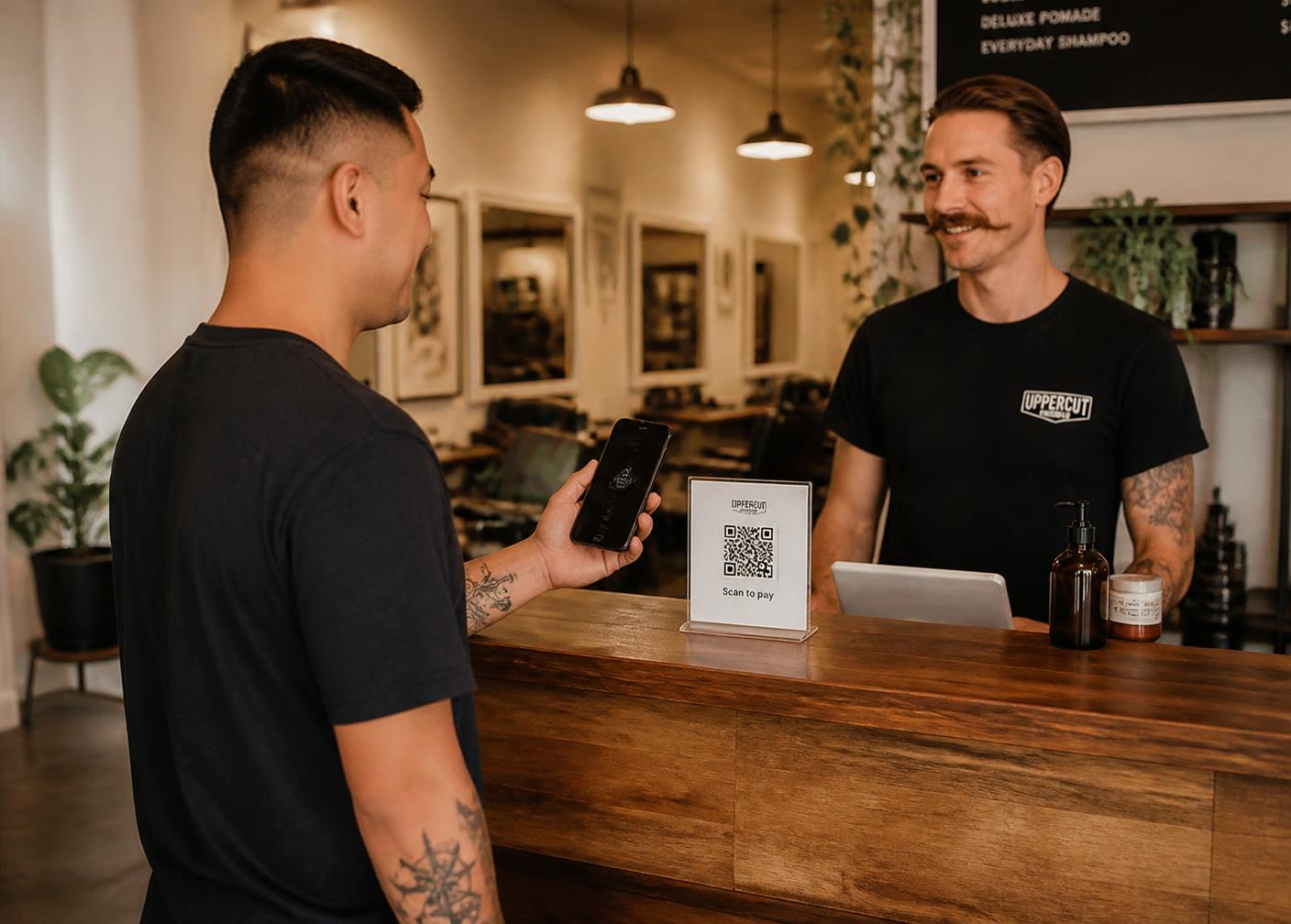
1. Place the QR code where the customer naturally looks
Useful locations include:
- The counter
- The mirror at each station
- The reception desk
- The booking confirmation
- A sign near the waiting area
- The shop window for walk-in customers
A single clear message is usually better than several competing signs.
For example:
2. Ask at a natural point in the visit
The end of the service is often a sensible moment. The client has finished the cut, is considering payment and can see the value of joining.
Staff do not need a long sales script. They can say:
If the client joins, confirm that the card has been added before they leave. Where the setup allows, apply the first visit at the same time.
3. Make stamping part of checkout
The person processing payment should know whether the loyalty action has been completed.
A basic process might be:
- 01Confirm the service qualifies.
- 02Ask the customer to show their digital card.
- 03Scan or update the card using the approved staff workflow.
- 04Confirm the new progress.
- 05Mention the next step only if it is useful.
This should work for both booked appointments and walk-ins. Do not create one process for regular bookings and another for casual customers unless there is a clear reason.
4. Decide how to handle corrections
Mistakes will happen. A staff member may forget to add a visit, add one twice or select the wrong customer record.
Write down who can correct an error and how the correction is recorded. A customer should not have to argue with the team about a missing stamp.
5. Be clear about no-shows and cancellations
A loyalty visit should normally relate to a qualifying completed service. If your business has different rules for late cancellations, state them plainly.
The aim is not to penalise customers. It is to prevent confusion and ensure the program reflects real completed activity.
Reward ideas for barbershops
A free haircut is one option, but it is not the only useful reward. It may also be one of the more expensive options because it uses chair time, products and staff capacity.
Consider rewards such as:
- A beard trim
- A hot towel shave
- A scalp treatment
- A styling upgrade
- A selected grooming product discount
- A product sample
- A complimentary finish or add-on
- A defined discount on a future service
Each option has a trade-off.
A service add-on may feel valuable while costing less than a full appointment. A product discount may suit customers who already buy grooming products, but it will not appeal to everyone. A free haircut is easy to understand, although the cost and capacity impact need careful consideration.
The reward should be relevant, simple to redeem and sustainable for the shop.
To assess the offer, calculate the real cost of providing it. Consider product costs, staff time, chair availability, service duration and whether the reward can be combined with other discounts.
For more detail, read How to Choose a Loyalty Reward Customers Actually Want.
Connect loyalty with the booking relationship
A loyalty card works best when the client can move easily from progress to the next appointment.
If your booking system supports it, include the booking link in the digital customer experience, confirmation messages or follow-up communication. Keep the route visible and mobile-friendly.
Do not assume that a loyalty platform automatically connects to every booking system. Check what your existing tools support before promising a joined-up process.
A practical customer journey may look like this:
Visit → Reward progress → Stay connected → Book again → Grow
A customer who has just received a cut may not need a reminder immediately. A useful follow-up could instead recognise the visit, show their updated progress or make the booking option easy to find when they are ready.
Predictable events can support useful follow-up, such as confirming a completed visit, updating reward progress or reminding a customer when a reward is available.
Common barber loyalty program mistakes
Making the reward too difficult to earn
If clients cannot see a realistic path to the reward, they may stop paying attention. Set the earning path with your normal customer cycle in mind.
Rewarding behaviour that hurts margins
A reward can create pressure if it uses a high-cost service or the busiest chair time. Check the economics before launching.
Using complicated rules
Multiple tiers, exclusions and different stamp values can create work at the counter. Begin with the simplest structure that reflects your business.
Stamping inconsistently
If one barber updates the card and another forgets, customers lose confidence. Make the loyalty step part of the normal payment process.
Ignoring walk-ins
Walk-in clients may be first-time customers who need the most obvious invitation to join. Make sure the same sign-up and stamping process works without a prior booking.
Treating no-shows inconsistently
Decide the rule in advance. Communicate it clearly and apply it consistently.
Sending too many messages
A digital card is not permission to send constant promotions. Keep communication relevant to the loyalty relationship and respect customer preferences and privacy obligations.
Launching without training
A ten-minute team walkthrough can cover the sign-up script, qualifying services, updating progress, corrections and reward redemption. Test the process with staff before inviting customers to use it.
How to launch a digital loyalty program for your barbershop
Use this process to keep the launch controlled.
- 01Choose the behaviour to reward.
For most barber shops, this will be a completed qualifying cut or service.
- 01Choose a sustainable reward.
Compare a free service, add-on, product benefit or discount against its actual cost.
- 01Set the earning rules.
Define qualifying services, walk-ins, cancellations, no-shows, expiry and redemption.
- 01Choose the simplest tracking structure.
A visit or stamp model may be enough. Use points or tiers only when they add a clear benefit.
- 01Prepare the digital card.
Add your shop name, branding, reward description and progress information.
- 01Create the QR sign-up points.
Place the code at the counter, chairs and other relevant customer touchpoints.
- 01Train every barber and front-counter team member.
Show them how to invite customers, update the card and correct mistakes.
- 01Test the complete journey.
Join as a new customer, add a visit, correct an error and redeem a reward.
- 01Launch with one clear message.
Explain how to join, how to earn and what the customer receives.
- 01Review usage quietly and regularly.
Check whether customers are joining, whether visits are being recorded and whether staff can operate the process without slowing down service.
How Reviewify fits
Reviewify helps local businesses create branded digital loyalty programs that customers can save to Apple Wallet or Google Wallet.
For a barbershop, that can include a branded digital card, QR sign-up, visit tracking and loyalty updates. The customer can keep the card on their phone rather than relying on a paper card or a separate loyalty app.
The setup should reflect the shop’s actual service model. A barber may begin with a simple visit-based reward, then consider other options such as a service add-on, product offer, membership or gift card where those formats make sense.
The broader journey is:
Visit → Reward → Stay connected → Follow up → Grow
Predictable events can support useful follow-up, such as confirming a completed visit, updating reward progress or reminding a customer when a reward is available.
The principle is straightforward:
Turn customers into regulars. Keep them coming back.
To see how the customer and staff journey could work, see how Reviewify works. To explore a version using your own shop details and branding, Create My Demo.
Summary
A digital loyalty program gives a barbershop a practical way to recognise completed visits and keep the next visit visible.
Start with a simple structure. Match the reward to your margins and service capacity. Make joining possible through a QR code at the chair or counter, then make updating the card part of checkout.
Apple Wallet and Google Wallet can provide a convenient home for the customer’s digital card. But the technology is only one part of the program. The reward must be useful, the rules must be clear and the team must apply them consistently.
A considered process can help turn a first appointment into the beginning of an ongoing customer relationship.